
As an Amazon Associate I earn from qualifying purchases.
Put a plain t-shirt on an anxious dog and you have a dog in a t-shirt. Put a pressure wrap on the same dog and you have something else entirely, even though the two garments can look similar hanging side by side. The difference is not the fabric, the color, or the brand name on the label. The difference is what the garment is engineered to do once it is on the body. A regular dog shirt is clothing. A wrap like the ThunderShirt is a tool, built to hold steady, even pressure against the torso from the moment it is fastened until the moment it comes off. This guide walks through that difference piece by piece, what each garment genuinely does, what the veterinary evidence says a wrap can and cannot deliver, and how to tell which one your dog actually needs before you spend anything.
New to calming garments? Start with the basics
Our complete guide to anxiety clothing for dogs covers the whole category, and the roundup of the best calming shirts for dogs compares the leading options side by side.
Key Takeaways
- A regular dog shirt hangs loose by design. It warms, covers, and looks good, but it applies no deliberate pressure, so it does nothing a wrap is built to do.
- A pressure wrap fastens snugly around the chest and torso and holds that contact while the dog moves, which is the entire basis of its calming claim.
- The veterinary evidence for wraps is modest and mixed. Reviews find small possible benefits for some dogs, not a reliable cure for anxiety.
- Fit is the mechanism. A wrap worn loose is just an expensive shirt, and a wrap worn too tight is a welfare problem, so the two-finger check matters.
- Severe fear, panic, and escape behavior belong with a veterinarian, not a garment. A wrap is one layer in a plan, never the whole plan.
Table of Contents
- The short answer, side by side
- What a regular dog shirt actually does
- What the wrap does differently
- What the evidence says, honestly
- Fit is the mechanism
- When a regular shirt is the right call
- When the wrap earns its place
- How to test the difference on your own dog
The short answer, side by side
One garment is clothing and the other is equipment. That single sentence explains most of the confusion in this category, because the two products share a shelf, a price range, and sometimes a name. Owners reasonably assume that a shirt sold for calming must work the way any shirt works, only better. It does not. The wrap works, to the extent it works at all, through sustained contact pressure, and everything about its construction serves that one job. The comparison below settles the structural differences before we get into evidence and fit.
| Feature | Pressure wrap | Regular dog shirt |
|---|---|---|
| Primary job | Hold gentle, constant pressure on the torso | Warmth, coverage, style, light protection |
| Fit | Snug, with full torso contact | Loose or relaxed, hangs from the shoulders |
| Fastening | Adjustable hook-and-loop panels you tension by hand | Pull-on, buttons, or a single chest strap |
| Pressure on the body | Deliberate and distributed across chest, ribs, and belly | Incidental, only where fabric happens to touch |
| Sizing basis | Chest girth first, weight second | Weight or breed guess is usually enough |
| Best use | Noise events, travel, vet visits, situational fear | Cold days, sun cover, shedding control, photos |
The terminology tangle makes this harder than it should be. Our explainer on the Thunder Shirt vs calming shirt question untangles brand names from category names, and the deep dive into dog compression shirts for anxiety covers how the wider wrap category is built. This post asks a different question, what separates any wrap from an ordinary garment, because that is the comparison owners actually face at the checkout.
What a regular dog shirt actually does
A regular shirt is honest clothing, and clothing has real jobs. A lightweight tee keeps a thin-coated dog warmer on a cold morning, shades a light or hairless back from the sun, holds shedding hair off the furniture, protects a healing scrape from licking paws, and gives a nervous dog a mild sense of being covered that some owners swear settles them a little. None of that is nothing. The mistake is expecting a calming effect the garment was never designed to produce. A pull-on shirt is cut to hang. It drapes from the neck and shoulders, skims the back, and leaves air gaps along the ribs and belly, and those gaps widen every time the dog sits, turns, or shakes.
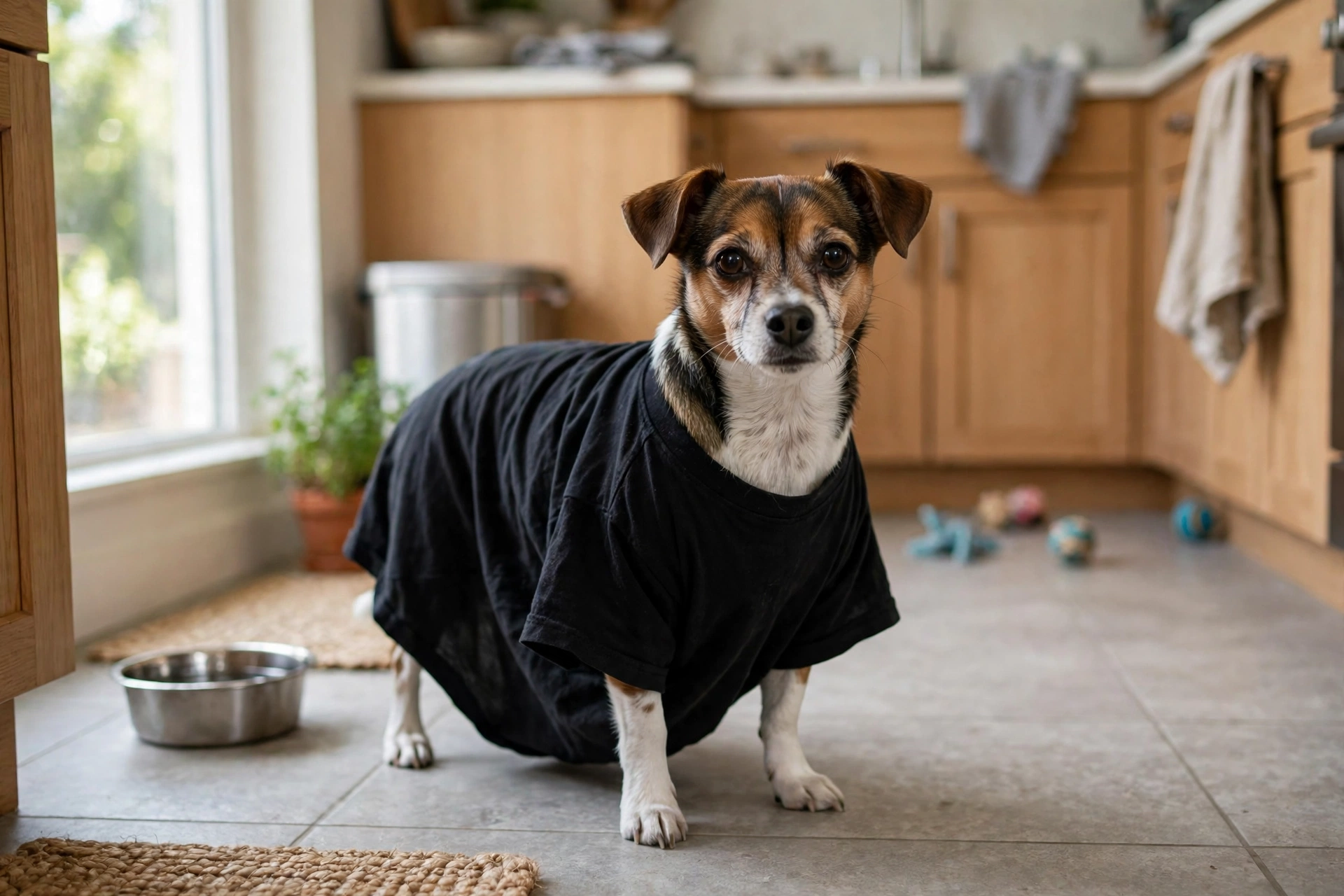
Look at how a basic tee sits and the point makes itself. The fabric touches the dog in a few places and floats free in the rest, so the only pressure the dog feels is the weight of the cloth itself. That is exactly what you want from everyday clothing, and products like the plain shirt below are good at their actual job, an inexpensive, washable layer for warmth and coverage. What they cannot do is maintain the constant torso contact that the whole pressure-wrap idea depends on, and no amount of sizing down turns a tee into a wrap, because a too-small shirt binds at the neck and leg holes while still gaping across the ribs. The construction is different, not just the tightness.

There is also a comfort argument for loose clothing that matters later in this guide. A dog who dislikes being handled or who overheats easily may accept a light shirt happily while fighting a wrap, and a garment the dog hates helps nobody. Our notes on anti anxiety shirts for dogs walk through what to check before buying anything in this aisle, including the dogs who should skip snug garments altogether.
What the wrap does differently
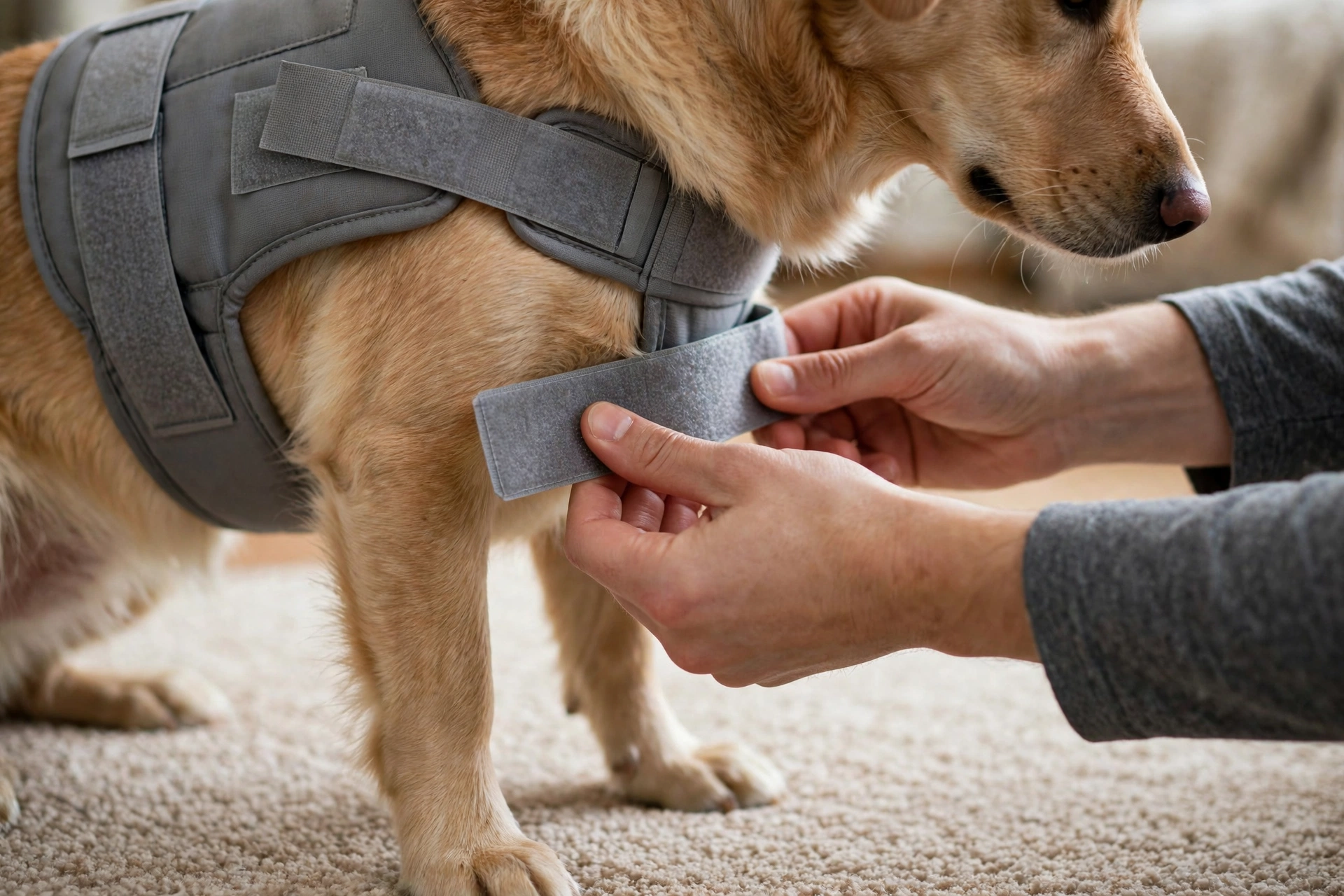
The wrap replaces drape with contact. A pressure wrap is patterned like a vest rather than a shirt, with broad panels that close around the neck and under the belly using wide hook-and-loop fasteners. When you fasten it properly, the fabric sits against the chest, ribs, and abdomen all at once, and the adjustable panels let you set how firmly it holds. The design idea, borrowed from swaddling and from the squeeze chutes used to settle livestock, is that steady pressure on the torso may lower arousal in some animals. PetMD describes pressure vests as fitted to use pressure points to ease fear or phobias during events like thunderstorms and fireworks, comparing the effect to a hug, while being careful to note the research behind that description is limited.
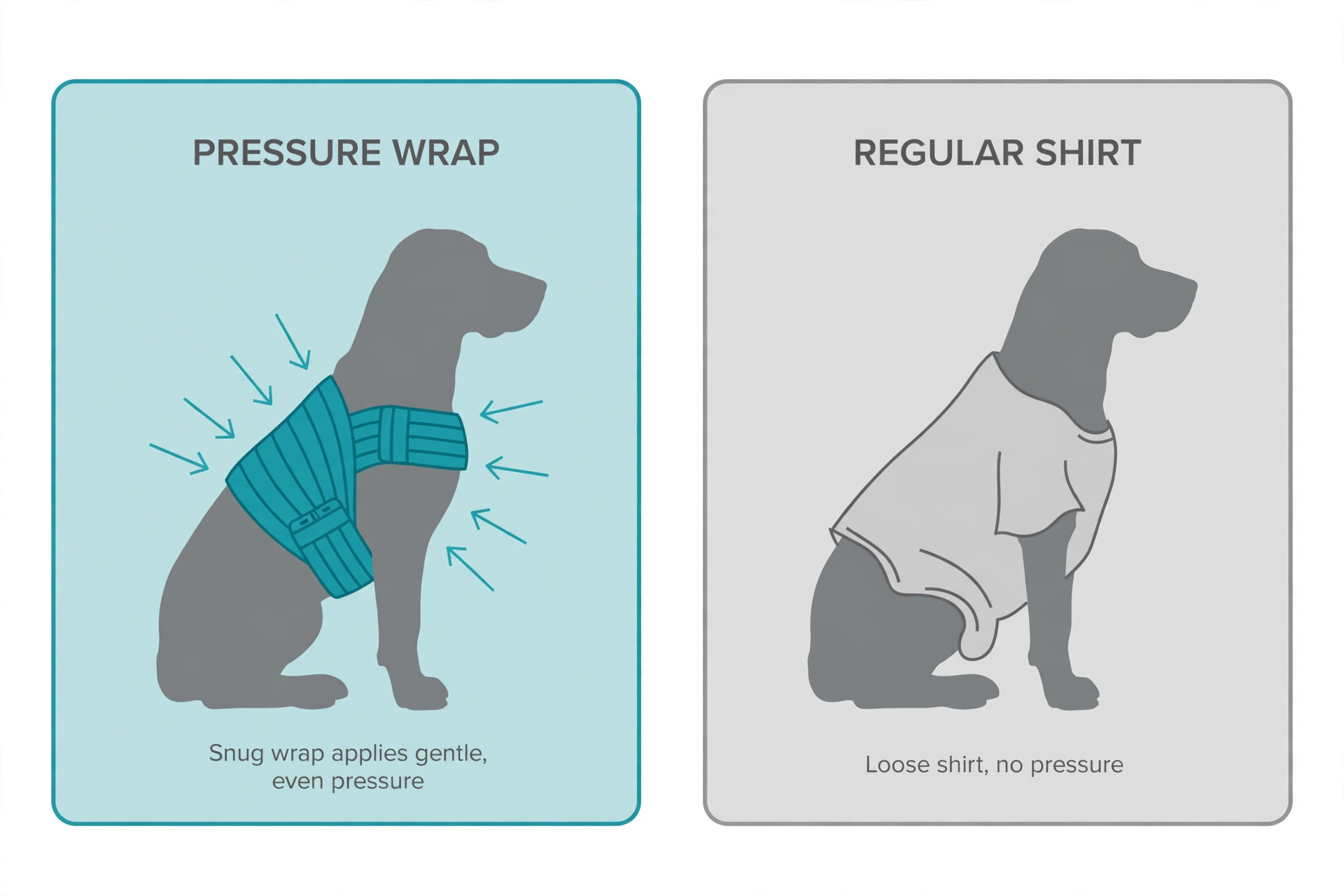
Three construction details do the work. First, coverage: the wrap spans the widest part of the ribcage, where a shirt often ends at the shoulders. Second, tension you control: the belly and chest flaps overlap, so the same wrap can sit firmer or gentler on the same dog, which no pull-on garment offers. Third, stability in motion: because the panels anchor at the neck and under the torso, the wrap stays in contact when the dog paces, which is precisely when an anxious dog needs whatever benefit it provides. A shirt, by contrast, twists and rides up on a pacing dog within minutes. The ThunderShirt Classic below is the reference design for the category, the one most other wraps are measured against, and our test-focused review asking does the ThunderShirt actually work looks at owner results in more depth.

None of this makes the wrap magic, and the honest framing matters. The wrap does not block sound, does not teach the dog that thunder is safe, and does not treat an underlying anxiety disorder. It offers one input, steady pressure, during events the dog finds frightening. Whether that input changes anything for an individual dog is an empirical question you answer by watching your own dog, which is why the test protocol near the end of this guide matters more than any marketing percentage.
What the evidence says, honestly
The research is thin, and you deserve to hear that plainly. A knowledge summary in Veterinary Evidence appraised the experimental literature on pressure vests in fearful and anxious dogs and found only four studies that qualified. Its conclusion was that vests may have small but beneficial effects, that the studies were of variable quality, that most positive behavior measures came from assessors who knew which dogs were wearing a vest, and that owners should not expect anxiety to be fully alleviated, or necessarily helped at all. PetMD lands in the same place, calling the research on pressure vests limited and inconclusive while noting that many owners in the studies believed their dogs were calmer, and that the products are low risk when fitted well.
The wider anxiety literature explains why a garment alone was never going to carry the whole load. The American Kennel Club notes that the best treatment plans usually combine training, preventive strategies, and sometimes medication, because anxiety has many causes, from fear and separation to aging. The Merck Veterinary Manual makes the same point from the clinical side, describing behavior modification through counterconditioning as central to treating fears and phobias, with medication added early in harder cases. Cornell’s Behavior Medicine service exists precisely because emotional disorders in dogs often need a full workup, a history review, and an individualized plan rather than a single product.
Where does that leave the wrap? As a reasonable, low-risk experiment for a dog with mild to moderate situational fear, worn alongside the management steps that do have support, a safe indoor space, sound masking, and a calm routine. The ASPCA recommends keeping dogs inside with a quiet room and background sound during fireworks, and the RSPCA advises the same kind of preparation, which tells you where the professional consensus puts its weight. A wrap can join that routine. It cannot replace it, and any seller who presents it as a standalone cure is telling you more about the seller than the science.
Fit is the mechanism
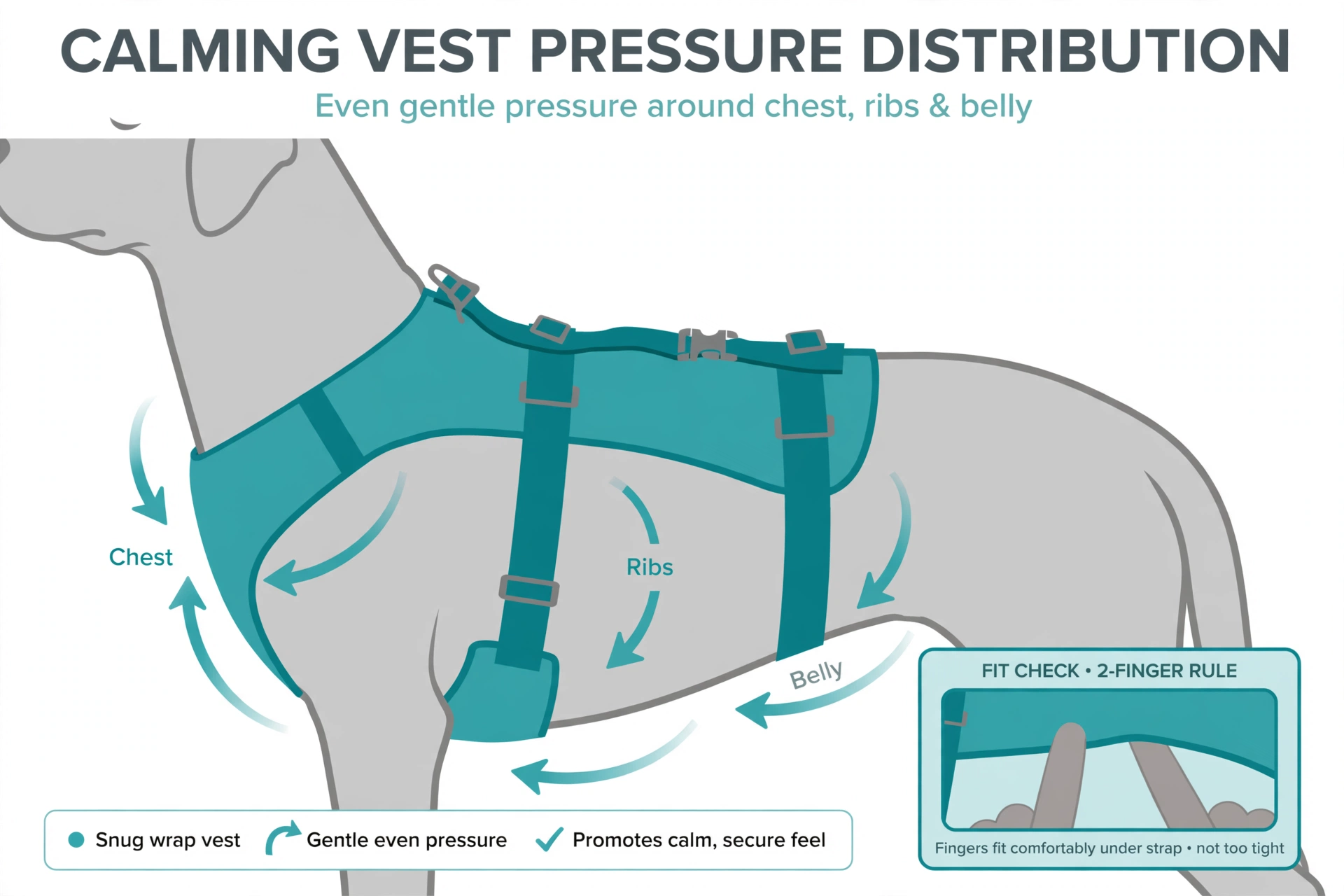
With a wrap, sizing is not a detail, it is the product. Because the proposed benefit comes from contact pressure, a wrap that gaps at the ribs delivers nothing, and a wrap cranked down hard enough to restrict breathing is a welfare problem wearing a calming label. PetMD gives the field check in one line: pressure vests are meant to fit snugly but not restrictively, and you should be able to slip two fingers with ease underneath the vest. That two-finger check, run at the chest and again at the belly panel, is the difference between a wrap and a very snug shirt.
Measure before you order. Wrap sizing runs on chest girth, measured around the widest part of the ribcage just behind the front legs, with weight as the tiebreaker, and the two measures regularly disagree in deep-chested and barrel-chested breeds. Our breed-focused guides to thunder shirts for large dogs and thunder shirts for small dogs show how differently the same product line fits at the two ends of the scale. The small Classic below is the same patented design as the large, sized for dogs whose chest measurements put them at the little end of the chart, and it makes the point that one wrap design spans the range only because the sizing is taken seriously.

Two more fit rules from the clinical guidance are worth memorizing. PetMD warns that pets should never be left unsupervised while wearing a vest or jacket, and that some dogs find a wrap fear-provoking rather than soothing, in which case the correct move is to take it off, not to insist. A regular shirt carries neither instruction, which is another quiet way of seeing that these are different categories of product.
When a regular shirt is the right call
Plenty of days call for clothing, not equipment. Choose the regular shirt when the job is warmth for a short-coated dog in winter, a barrier between a healing hot spot and the dog’s tongue between cone sessions, sun cover for a pale belly on a bright hike, or a layer that keeps loose hair off the car seat. Choose it, too, when your dog simply hates snug garments. Some dogs freeze, paw at fasteners, or pant harder in a wrap, and a dog communicating that clearly should be believed. The ASPCA reminds owners that anxious behavior is distress, not disobedience, and that principle applies to clothing trials as much as to training: the goal is a calmer dog, not a dog who has stopped objecting.
Budget honesty belongs here as well. A basic tee costs a few dollars and washes like a rag, while a branded wrap costs as much as a bag of premium food. If your dog’s problem is cold ears and a drafty house, the tee wins outright. If your dog’s problem is mild unease on car rides, our guide to calming dog shirts for summer covers lighter options, and the DIY calming dog shirt walkthrough shows how owners improvise snug layers at home, with the caveat that a homemade layer imitates a wrap’s fit without its tested construction. Spend wrap money only when the problem is actually fear.
When the wrap earns its place
The wrap’s case is situational fear with a start and an end. Thunderstorms and fireworks are the classic triggers, and they are the situations the research and the product design both target. Cornell’s Riney Canine Health Center, in its guidance on sound sensitivities, advises owners of noise-phobic dogs to plan ahead with a quiet room, layered sound to mask the noise, long-lasting treats, and prescribed medication given early, because preventing a fear reaction is far easier than stopping one underway. A wrap fitted before the first rumble fits naturally into that plan. VCA Hospitals likewise frames storm and fireworks phobias as conditions managed with behavior modification started in the quiet season, plus event-day management, which is the honest context for any garment.
Travel and appointments make the same short list. A dog who trembles in the car or shakes on the vet’s table faces a bounded event with a clear beginning, and a wrap put on at home, where the dog is calm, can be part of the routine that gets them through it. What the wrap is not for is round-the-clock wear as a substitute for treating separation anxiety or generalized fear. The AKC describes separation anxiety as a panic-like condition that responds to structured training and, in serious cases, medication, and no garment is a plan for that. And when fear is severe, the escalation path is pharmaceutical as well as behavioral: the FDA approval summary for Sileo documents a prescription gel approved specifically for noise aversion in dogs, and PetMD explains how it is used. A dog who injures himself trying to escape a storm needs that conversation with a veterinarian, not a tighter vest.
How to test the difference on your own dog
Run the comparison like an experiment, not a hope. Start on a calm day with no storm forecast. Put the wrap on for ten minutes while nothing scary is happening, fasten it to the two-finger standard, and watch what your dog does with his body. A dog who settles, sighs, and lies down is giving you data. A dog who freezes statue-still, whale-eyes, or scratches at the panels is giving you different data, and freezing in particular is often misread as calm when it is actually shutdown. Repeat on two or three quiet days so the garment itself becomes boring, because a wrap first introduced during a panic gets blamed for the panic.
Then use the next mild event as the real trial, with the rest of the routine in place: dog inside before the noise, safe room ready, background sound on, the steps the ASPCA and the RSPCA both recommend. Compare against your dog’s usual storm behavior honestly: pacing, panting, drooling, hiding, and how long recovery takes after the noise ends. If the wrap earns a repeat, keep it in the routine. If nothing changes after several fair trials, believe the result, return to the regular shirt for the jobs clothing does well, and put the money toward a behavior consult instead. Our roundup of the best comfort dog anxiety shirts and the profile of the Mellow Shirt for dogs cover the softer middle ground between a tee and a full wrap if you want to keep experimenting.
Our view: the regular shirt and the wrap are not rivals, they are answers to different questions. Clothing warms, covers, and protects. A wrap adds one specific tool, sustained torso pressure, that helps some dogs through frightening events and does nothing measurable for others. Buy the garment that matches the problem in front of you, fit it like it matters, because with a wrap it does, and judge it by your own dog’s body language rather than anyone’s success-rate claim, including ours.
Frequently Asked Questions
Can a regular t-shirt calm an anxious dog?
Not through pressure, because a loose shirt does not maintain contact with the torso. Some dogs do seem to settle slightly when covered, and a shirt can help indirectly by keeping a dog warm and reducing drafts during a storm, but that is comfort, not the wrap mechanism. If fear is the problem, test a proper wrap or talk to your veterinarian.
How tight should a pressure wrap be?
Snug, with full contact across the chest and belly, and loose enough that two fingers slide underneath the fabric with ease, the standard PetMD gives for pressure vests. If you cannot fit two fingers, loosen it. If the panels gap when the dog moves, snug it one step at a time and recheck.
Can my dog wear a wrap all day?
No. Wraps are event tools, put on before a frightening situation and taken off after it passes, and dogs should not be left unsupervised while wearing one. All-day wear risks overheating, skin irritation, and a dog who habituates to the pressure so completely that it stops registering at all.
What if my dog hates the wrap?
Take it off. A minority of dogs find close-fitting garments frightening or uncomfortable, and forcing the issue teaches the dog that storms now come with an extra unpleasant step. Go back to environmental management, and raise the reaction with your veterinarian at the next visit.
Is the ThunderShirt the only real wrap?
It is the best-known and the design most of the research used, but the category includes other compression garments built on the same principle. What separates any of them from a regular shirt is construction: full torso coverage, adjustable tension, and a fit that holds contact in motion.
Still deciding between garments?
Browse the full Dog Anxiety and Calming collection of guides, or start from The Pet Shirts home page for both lanes of the site, problem-solving dog shirts and graphic tees for people.
Sources
- PetMD, Calming Aids for Dogs
- Veterinary Evidence, pressure vest knowledge summary
- American Kennel Club, Anxiety in Dogs
- American Kennel Club, Separation Anxiety in Dogs
- Merck Veterinary Manual, Behavior Problems of Dogs
- VCA Hospitals, Helping Dogs with Severe Phobias
- Cornell Riney Canine Health Center, Sound Sensitivities
- Cornell University, Behavior Medicine Service
- ASPCA, Fourth of July Safety Tips
- ASPCA, Separation Anxiety
- RSPCA, Fireworks Advice
- FDA, Sileo Freedom of Information Summary
- PetMD, Sileo for Dogs