As an Amazon Associate I earn from qualifying purchases.
Every calming shirt comes with the same unhelpful instruction: fit it snugly. Snug covers a wide and worrying range, from a wrap so loose it twists sideways in ten minutes to one cranked down hard enough to change how a dog breathes. The truth is that fit is not a finishing touch on a calming shirt, it is the entire mechanism, and there is a simple field test that settles it in seconds: two fingers, slid flat under the fabric, at the chest and again at the belly. This guide explains what that check is really measuring, how breathing and movement should look at the right tightness, how to measure and size so the check passes on the first fitting, and the warning signs that mean loosen it, resize it, or take it off entirely.
Fitting one for the first time?
Pair this guide with the size-focused roundups for thunder shirts for large dogs and thunder shirts for small dogs, where chest measurements do the deciding.
Key Takeaways
- The standard is two fingers sliding with ease under the fabric at the chest and the belly, the fit check veterinary guidance gives for pressure vests.
- Too loose fails quietly: the wrap gaps, twists, and delivers no steady pressure, so the dog gets a shirt, not a wrap.
- Too tight fails loudly: watch for changed breathing, restlessness, pawing at straps, and a dog who cannot settle or move naturally.
- Size by chest girth measured behind the front legs, not by weight alone, and recheck the fit after ten minutes of movement and again mid-event.
- Some dogs should not wear a wrap at all, including dogs with breathing problems, chest injuries, or a clear hatred of snug garments.
Table of Contents
- The answer first, snug with two fingers of proof
- How to run the two-finger check properly
- Breathing, the line that matters most
- Too loose, the silent failure
- Too tight, the signs your dog gives you
- Measure and size so the check passes
- The movement test and the mid-event recheck
- Dogs who should skip the wrap
The answer first, snug with two fingers of proof
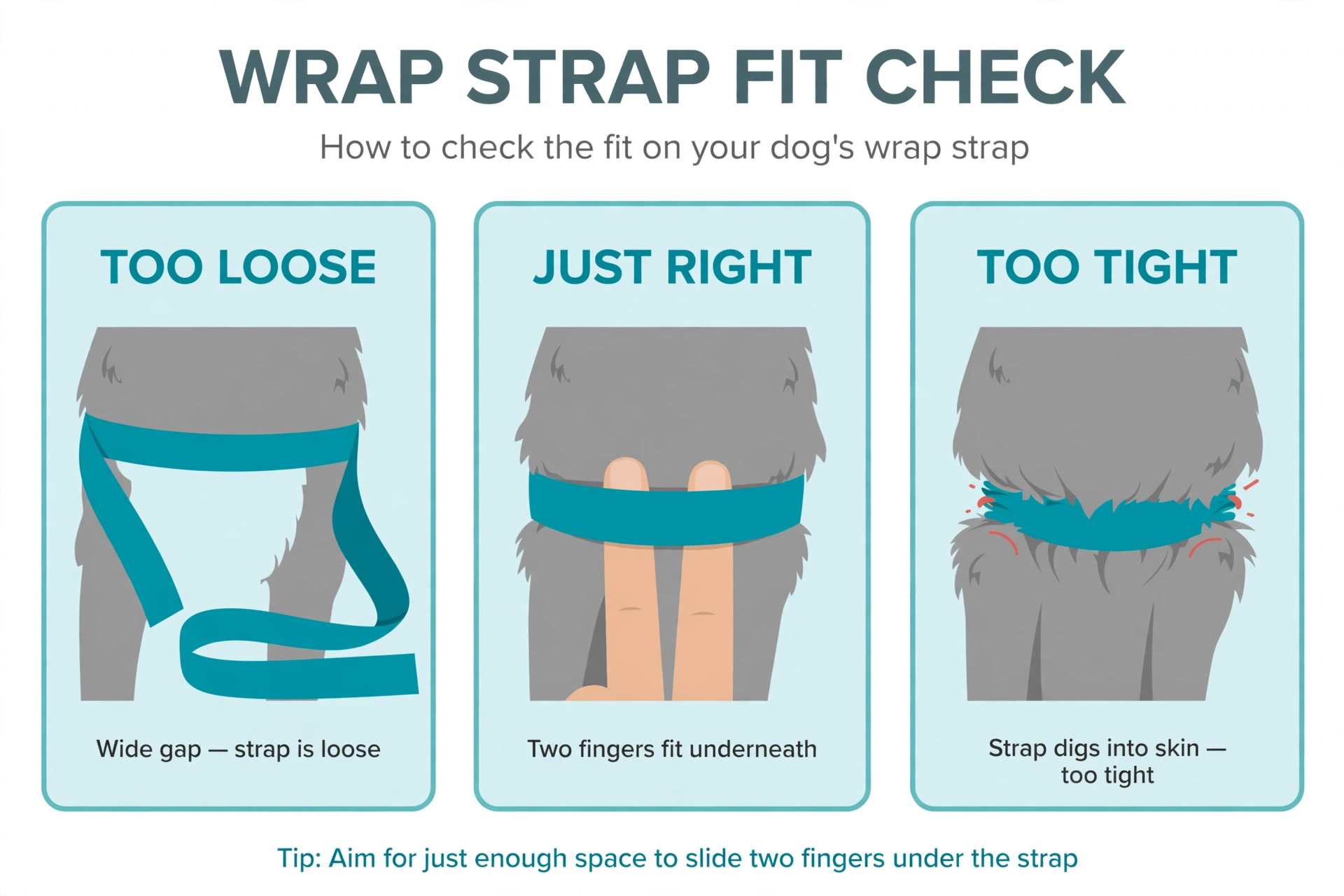
A calming shirt is right when it holds full, even contact with the torso and still lets two fingers slide underneath with ease. That is not folk wisdom from a product box; it is the standard PetMD gives for pressure vests, stated in one sentence: the vests are meant to fit snugly but not restrictively, and you should be able to slip two fingers with ease underneath. Everything else in this guide is commentary on that sentence. Contact is the point of the garment, since the proposed calming effect comes from steady pressure across the chest, ribs, and belly, the mechanism our comparison of the Thunder Shirt vs calming shirt designs explains in detail. The two fingers are the safety margin that keeps that pressure in the gentle range.
| Check | Too loose | Just right | Too tight |
|---|---|---|---|
| Two-finger test | Whole hand fits, fabric gaps | Two fingers slide with ease | Fingers will not fit or must force |
| Fabric contact | Touches shoulders only, twists in motion | Even contact chest, ribs, belly | Digging in at neck and leg openings |
| Breathing | Normal | Normal, full easy breaths | Shallow, fast, or noisy |
| Movement | Wrap rotates, dog steps out of panels | Walks, sits, lies down naturally | Stiff gait, reluctance to lie down |
The honest context belongs up front too. The appraisal in Veterinary Evidence found that pressure vests may have small but beneficial effects for some dogs and none for others, which means a correct fit gives the garment its fair chance, not a guaranteed result. Fit cannot rescue a dog whose fear needs a veterinarian, and it cannot ruin a tool that was only ever going to be one layer of help. What it can do is make sure that when you judge the result, you are judging the wrap and not your fastening technique.
How to run the two-finger check properly
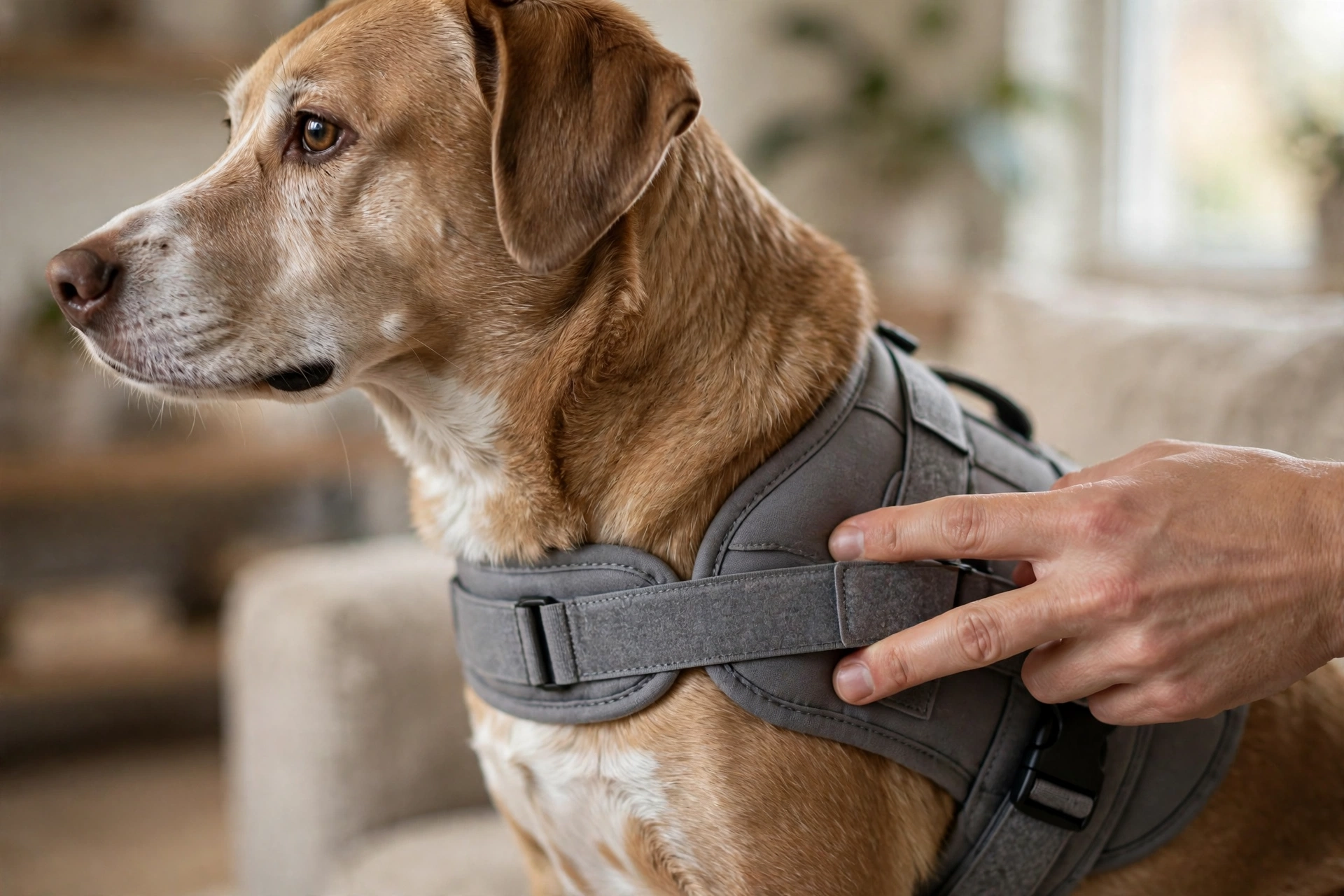
Run the check flat, at two stations, on a standing dog. Slide two fingers, held flat against the dog’s body rather than poked in fingertip-first, under the chest panel where it crosses the widest part of the ribcage. They should glide in with mild resistance and sit there without you holding them in place by force. Then repeat under the belly panel, because wraps are tensioned by overlapping flaps and the belly is where owners most often over-tighten while chasing a neat look. Finish at the neck opening with a single finger, since the neck carries no pressure job and should sit closest to a collar’s looseness. If any station fails, adjust that panel only, then run the whole check again, because loosening the belly changes how the chest sits.
Timing matters as much as technique. Run the first check the moment you fasten the wrap, then again after ten minutes of the dog walking around the house, because fabric settles, fur compresses, and a fit that passed standing still can gap once the dog has paced a few circuits. PetMD pairs the fit guidance with a supervision rule worth treating as part of the check: pets should never be left unsupervised while wearing a vest, jacket, or cape, which means the person who ran the check stays in the room to keep running it. The Classic below is the design this routine was built around, with the wide overlapping panels that make station-by-station adjustment possible in the first place.

Breathing, the line that matters most
Of everything fit affects, breathing is the non-negotiable. A wrap works on the torso, and the torso is where the breathing machinery lives, so the margin for error is real even though a correctly fitted wrap comes nowhere near restricting a healthy dog. Learn your dog’s resting breathing before any garment enters the picture: at rest, most dogs breathe in a slow, easy rhythm with the ribs rising and falling in a full, unhurried arc, and the belly moving gently with them. In the wrap, that picture should look essentially unchanged. A dog whose breaths become short and shallow, whose ribs flare outward at the sides instead of lifting, or who starts open-mouth panting in a cool room while standing still is telling you the pressure is wrong, the moment is wrong, or both.
The clinical sources draw the same boundary. The Merck Veterinary Manual lists the autonomic signs of acute fear and anxiety, including rapid breathing and excessive salivation, which is exactly why a tight wrap is such a trap for beginners: over-tighten the garment and you can manufacture the very signs you then read as proof the dog needed it tighter. Break that loop by checking breathing against the dog’s own calm baseline, not against how anxious you expect him to be. Cornell’s guidance on sound sensitivities describes the genuine fear picture during noise events, trembling, panting, pacing, and drooling among it, so on a storm night you judge the wrap by whether breathing eases over the first half hour, not by whether every sign vanishes.
Heat is the quiet partner of breathing in every fit decision. A snug synthetic layer on a panting dog in a warm room stacks insulation on top of exertion, and panting is how dogs dump heat. Our guide to calming dog shirts for summer covers the warm-weather end of this, lighter fabrics, shorter sessions, and cooler rooms, and the rule generalizes: if the room is warm enough that you are in a t-shirt, shorten the session and check the dog’s ears and belly for heat with the back of your hand every few minutes.
Too loose, the silent failure
A loose wrap does not announce itself, it just quietly becomes a shirt. The signs are mechanical: panels that gap when the dog inhales, a wrap that rotates so the belly flap ends up along the ribs, fabric bunching at the neck while the chest floats free, and a dog who can scratch a hind foot up under the edge. Each of those means contact is broken across exactly the area the pressure is supposed to cover. Owners drift loose for kind reasons, worry about comfort, a dog who fussed during fastening, a size bought with growing room, but the result is a fair test wasted. If you conclude wraps do not work for your dog based on a garment that never held contact, you have not actually run the experiment.
The fix is sizing before it is tension. A wrap at the top of its size range, fastened at the very ends of its panels, will gap no matter how you arrange it, while the size down, fastened mid-panel, holds contact with adjustment room in both directions. That is why the small Classic below exists as its own size rather than a suggestion to cinch the large one down: the panel geometry is cut for a small torso, so the two-finger check passes at the chest and the belly at the same time, which a downsized large rarely manages on a little dog.

Rechecks catch drift. Fur compresses under pressure within the first quarter hour, hook-and-loop panels creep a few millimeters at a time on a pacing dog, and a wrap checked once at fitting time can be a size looser by the middle of a storm. Build the recheck into the routine: fit, ten minutes of movement, check again, then once more whenever you pass the dog during the event. Our event-night sequence in the fireworks playbook treats that mid-event check as a standing step, and the deep dive into dog compression shirts for anxiety explains how different fastening systems hold or lose tension over a long evening.
Too tight, the signs your dog gives you
Dogs vote on fit with their whole bodies, and the ballot is easy to read once you know the tells. The too-tight picture: a dog who stands planted and will not lie down, because lying down increases pressure on the ribs; a dog who paces with a stiff, tucked posture rather than his normal stride; repeated pawing or rolling aimed at the panels; lip licking and yawning in a dog who is not tired; and the breathing changes covered above. The American Kennel Club lists the general anxiety repertoire, panting, pacing, restlessness, and drooling among it, which is precisely the overlap that makes tightness tricky: the garment meant to treat those signs can cause them, and the only way to tell the difference is to loosen one step and watch whether the dog’s body softens.
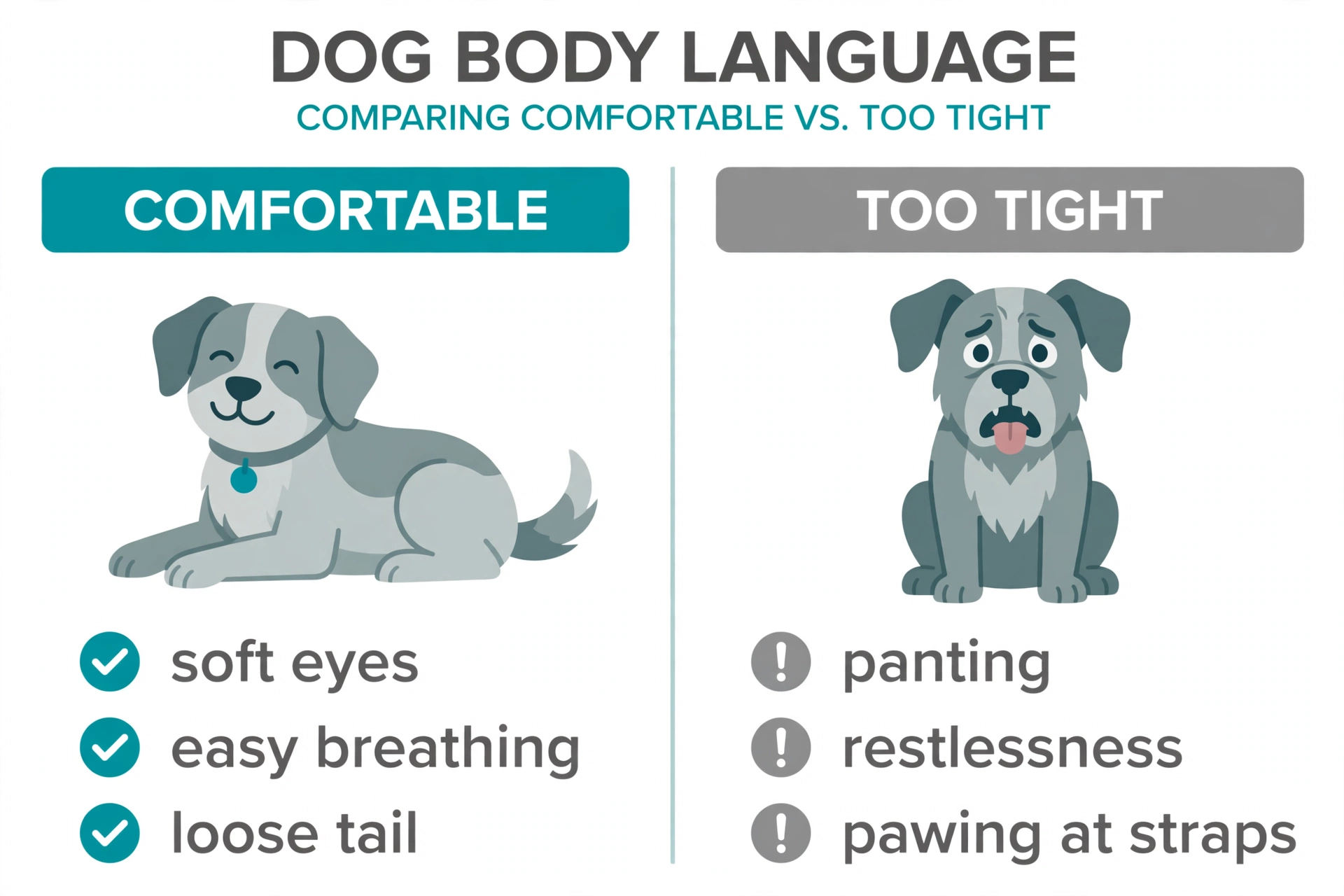
Freezing deserves its own warning because it fools caring owners every day. A dog who goes statue-still the moment the wrap closes is often recorded as instantly calmed, when stillness in a dog who was pacing a second earlier is just as likely to be shutdown, the dog enduring the garment rather than relaxing into it. The test is what happens over the next minutes: a genuinely settling dog sighs, shifts weight, looks around with soft eyes, and eventually lies down in a normal curve. A shut-down dog stays rigid, avoids eye contact, and startles harder at the next noise. ASPCA guidance on anxious behavior makes the underlying point that distress signals are communication to be answered, not obstacles to push through, and a wrap fitting is a small, clear place to practice believing them.
Measure and size so the check passes
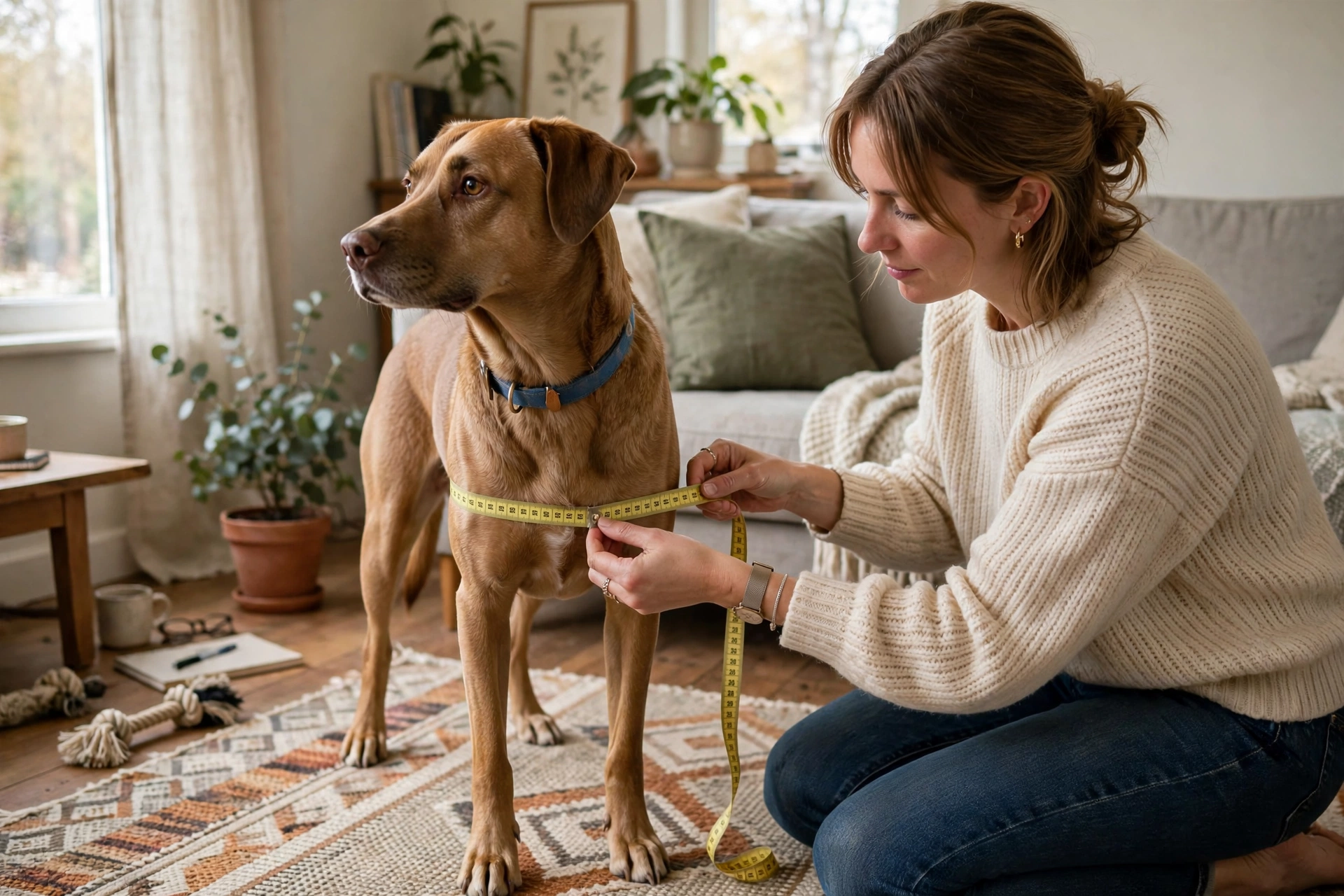
Chest girth is the measurement that decides everything. With the dog standing, run a soft tape around the widest part of the ribcage, just behind the front legs, snug against the fur without compressing it, and write the number down. Then weigh the dog, because wrap charts use weight as the second column, and when the two columns point at different sizes, girth wins: the garment has to close around the chest it actually meets. Deep-chested breeds regularly size up past their weight, and barrel-chested, short-backed dogs regularly size by girth into a wrap whose length then needs checking against the back, so the belly panel ends before the hips rather than riding over them.
Between sizes is the commonest real-world case, and the answer is the size whose panels you will fasten in the middle of their range, not at the extremes. A wrap fastened at the last centimeter of its flaps has no loosening room for a hot evening; one fastened with the flaps barely overlapping has no tightening room for the mid-event recheck. The Sport cut below, with its longer adjustable panels, is the forgiving option for in-between and oddly proportioned dogs, and its reflective trim is a bonus for the last yard trip on a loud night. If neither size lands mid-range, that brand’s geometry does not fit your dog, and a different cut will serve you better than force. Our category overview of anxiety clothing for dogs compares how the main designs handle the in-between problem.

The movement test and the mid-event recheck
A wrap is fitted standing still and judged in motion. After the two-finger check passes, ask for the dog’s ordinary repertoire: a walk across the room, a sit, a down, a turn in a tight circle, and a shake. Watch the panels through all of it. The chest strap should stay behind the front legs rather than sliding into the armpits, the belly panel should stay under the belly rather than migrating toward the ribs, and the neck opening should not saw at the throat when the dog lowers his head to sniff. A dog who moves through the whole sequence with a normal stride and a loose tail has passed the only fitting exam that counts.
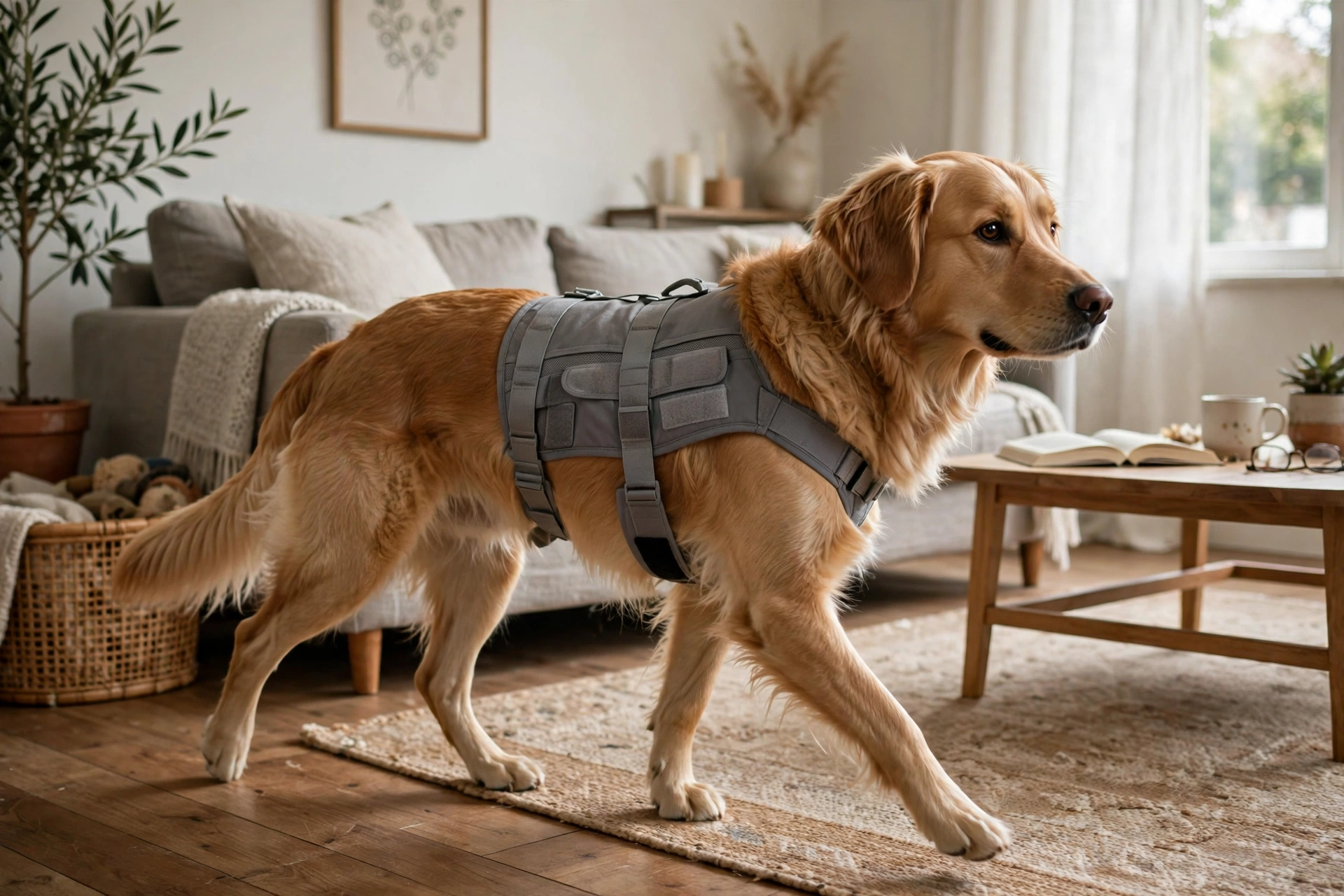
Then keep testing, because fit is a session-long condition, not a moment. Recheck after the first ten minutes, again when the event peaks, and any time the dog’s behavior changes suddenly, since a worked-loose panel and a genuinely rising panic can look similar from across the room. VCA Hospitals frames event management as something that starts before the noise and stays supervised through it, and the recheck habit is that supervision made concrete. Take the wrap off when the event ends and the dog has settled; a calming shirt is session equipment, and skin, coat, and the dog’s association with the garment all benefit from a clear off signal. Owners who improvise their own layers should hold the same standard, and our DIY calming dog shirt guide runs the same two-finger and movement checks on homemade versions.
Dogs who should skip the wrap
Fit has a hard boundary: some dogs should not be fitted at all. Dogs with breathing compromise, including many flat-faced breeds in hot weather, dogs with chest or rib injuries, recent torso surgery, or skin wounds under the panel area, and dogs whose panic at snug garments is itself the loudest signal they give, all belong in the skip column until a veterinarian says otherwise. The AKC describes how serious anxiety conditions, separation anxiety among them, call for structured training and sometimes medication rather than products, and Cornell’s Behavior Medicine service is the level of help a dog who injures himself in panic actually needs. For noise fear at the severe end, prescription treatment exists specifically for the condition, as the FDA approval summary for Sileo documents and PetMD explains for owners.
Skipping the wrap is not skipping help. The environmental half of the playbook, safe room, sound masking, an early walk, a calm human on site, the routine the ASPCA and the RSPCA both recommend for fireworks, carries no fit risk at all and helps every dog, including the ones in the skip column. And a dog who tolerates a loose shirt happily still gets the warmth and coverage benefits of ordinary clothing, which our rundown of the best comfort dog anxiety shirts covers for owners looking at the gentler end of the category. The goal was never the garment. The goal is a dog who breathes easy, in every sense, on the nights that used to undo him.
Our view: tightness is a measurement, not a vibe. Two fingers at the chest, two at the belly, breathing unchanged, movement unaltered, and a dog whose body softens instead of stiffening, that is the whole standard, and it takes under a minute to verify. Fit to that standard and you have given the wrap its honest chance; fit by eye and hope, and you have bought an expensive shirt and a story about whether wraps work that your dog never got to vote on.
Frequently Asked Questions
How tight should a calming shirt be, in one sentence?
Snug enough to hold even contact across the chest, ribs, and belly, and loose enough that two fingers slide underneath the fabric with ease at both the chest and the belly, the standard PetMD gives for pressure vests.
What if two fingers fit at the chest but not the belly?
Loosen the belly panel one step and recheck both stations, since the panels interact. If the belly only passes when the chest gaps, the wrap is the wrong size or the wrong cut for your dog’s proportions, and forcing the compromise leaves you with the worst of both fits.
How often should I recheck the fit?
At fastening, again after ten minutes of movement, once more mid-event, and whenever the dog’s behavior changes abruptly. Fur compresses and panels creep, so a fit verified once is a fit that was right once.
Can a wrap be too tight if my dog seems calm in it?
Yes, if the calm is actually freezing. A settled dog breathes slowly, shifts position, and eventually lies down in a relaxed curve. A rigid, silent dog with hard eyes who startles at every sound is enduring the garment, and the correct response is to loosen it and watch for the body to soften.
Should I size by weight or by chest measurement?
By chest girth first, measured around the widest part of the ribcage behind the front legs, with weight as the tiebreaker. When the two disagree, girth wins, because the wrap has to close correctly around the chest it actually meets.
More fit and sizing help
Browse the Pet Shirt Guides for measuring, sizing, and care walkthroughs, or start from The Pet Shirts home page for the full site.
Sources
- PetMD, Calming Aids for Dogs
- Veterinary Evidence, pressure vest knowledge summary
- Merck Veterinary Manual, Behavior Problems of Dogs
- Cornell Riney Canine Health Center, Sound Sensitivities
- American Kennel Club, Anxiety in Dogs
- American Kennel Club, Separation Anxiety in Dogs
- ASPCA, Separation Anxiety
- ASPCA, Fourth of July Safety Tips
- VCA Hospitals, Helping Dogs with Severe Phobias
- Cornell University, Behavior Medicine Service
- FDA, Sileo Freedom of Information Summary
- PetMD, Sileo for Dogs
- RSPCA, Fireworks Advice